Drahtsicht am Kalvarienberg
Museum
-
Wire view at the Calvary©
Description
If you walk carefully through the vineyards, you will find seedlings here and there, protected by covers so that they are not exposed to hungry rodents. At the edge of the vineyard, disused vines are piled up into macabre mountains of bones. Next to them, the climbing aids that have supported the shoots and grapes for many years are rotting away. Whole rolls and chaotic tangles of rusting wires, wrapped in the remains of grapevines, lie there.
The tying methods have changed over the many years of cultivating the vineyard: There is nothing left of the originally used vine twine. The plastic straps and colorful clips, which appear to be rot-proof, are all the more tenacious.
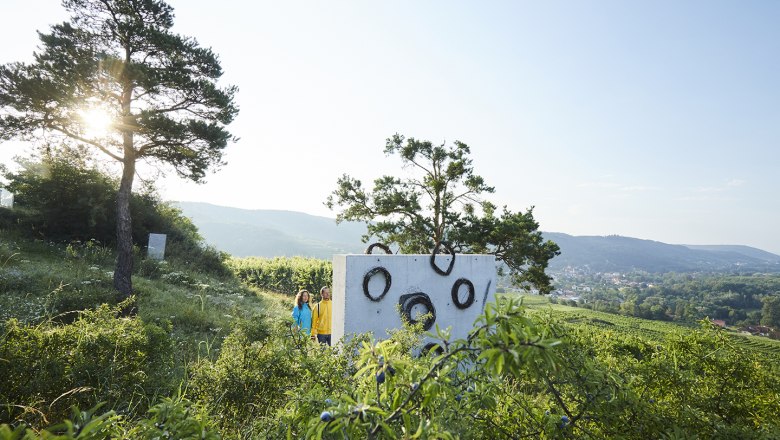
Similar to a fossil find, Wolfsberger embeds the wire rings in concrete to make the finds visible and convey the feeling that some of the rings are hidden inside, preserved for eternity. The amorphous wire rings together with the organic stubble-like vine shoots appear to be an archaeological find.
The art object "Drahtsicht" is named after its position on a slope of the Kalvarienberg, which offers a wonderful view of the Alpine foothills. The cuboid was carefully placed on a nature-protected site.
A few meters up the Kalvarienberg, walkers encounter two further art projects that were created in collaboration between Kunst im öffentlichen Raum Niederösterreich and the Weltklasse! Kunst & Wein, Kunstwege im Kamp Valley ("Kamptal" in German) association. Norbert Maringer's "Sitzplatzskulptur" was opened back in 2009, followed four years later by Herbert Golser's "Mondrohr". What all three works have in common is an intensive examination of cultural history and a fascination with the beauty of the surrounding landscape.