Malteserkirche Spital
Church
-
cath__parish_church_of_hl__johannes_der_taeufer_und_friedhof_in_spital_c_duke_of_w4©
Description
Information about the church
Spital is one of the oldest villages in the Waldviertel, which according to tradition was originally called "Schön Blumau".
The village was probably founded around the middle of the 12th century under Kuenring sovereignty and was donated by Hadmar II von Kuenring to the Order of St. John (later the Order of Malta) around 1200. The Knights of St. John built a hospital here at the fork of the Böheim and Polansteig rivers, which is mentioned in a document in 1227.
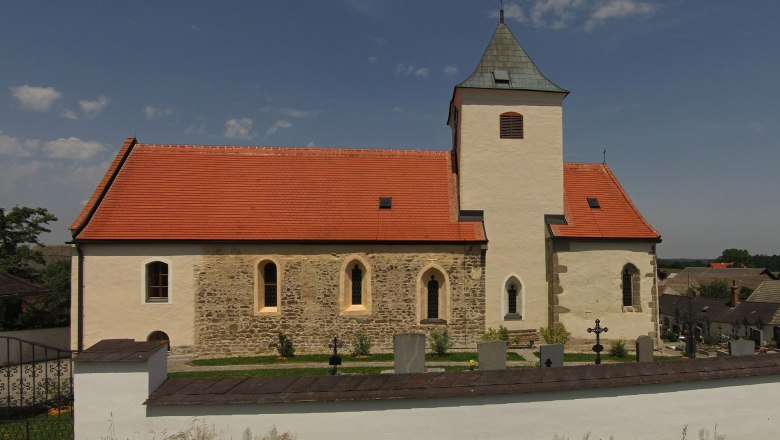
The parish church is surrounded by a cemetery and is one of the art-historical highlights of the area. The Romanesque nave with Gothic modifications is adjoined by a recessed Romanesque east tower. To the west is a baroque west bay of the nave with an unadorned gable façade. A Gothic choir in the width of the nave adjoins the tower to the east. To the north of the tower is a baroque sacristy annex. The interior design of the Romanesque tower is particularly remarkable: the tower bay is completely covered by wall paintings from the 14th century (around 1360), which were uncovered in 1983.
The parish church is dedicated to St. John the Baptist. A parish was first mentioned in documents in 1298. Until 1995, the parish was incorporated into the Maltese community of Mailberg and then became a world parish of the diocese of St. Pölten. From 2016, the parish, together with St. Wolfgang, will receive pastoral care from Zwettl Abbey.
The church and cemetery are listed buildings.
Treat yourself
John the Baptist, a central figure in the New Testament and patron saint of Spital parish church, is known for his ascetic lifestyle, his preaching of penance and his role as a forerunner of Jesus Christ. He embodies the principle of inner contemplation and self-reflection in a special way.
The life of John the Baptist
John the Baptist lived in the desert, far from the comforts and distractions of society. His clothing made of camel hair and his diet of locusts and wild honey are symbols of his strict asceticism and his life of seclusion. John's message was one of radical rethinking and inner conversion: he called people to repentance and prepared them for the coming of the Messiah.
John baptized Jesus in the Jordan, and this moment marked the beginning of Jesus' public ministry. John considered himself insignificant compared to the one who was to come after him.
"Treat yourself to yourself"
"Treat yourself" in the life of John the Baptist can be understood as a call to self-commitment and inner preparation. John withdrew into the desert, not to turn away from the world, but to concentrate on the essential task of his life: preparing people for the coming of Christ. His life of solitude and asceticism were an expression of a deep inner focus on God.
John's retreat into the desert can be understood as a form of self-discovery and inner clarity. He allowed himself the time and space to concentrate fully on his mission. This inner retreat enabled him to proclaim a powerful and unwavering message.
Conclusion
"Indulge yourself" in relation to John the Baptist means consciously withdrawing from the distractions of the world in order to focus on what is essential - preparing for an encounter with the divine. John shows us that true self-care sometimes lies in the radical decision to let go of the outer world in order to be inwardly ready for the spiritual tasks and callings that lie ahead. His life teaches us that there is a deep power in silence and solitude that enables us to recognize and fulfil our destiny.
"A voice cries out: 'In the desert prepare the way of the Lord; make straight in the desert a highway for our God'" (Isaiah 40:3)
This biblical passage emphasizes John's role as a voice in the desert, calling us to inner reflection and preparation for the coming of God. It is an invitation to withdraw oneself in order to prepare the way for deeper spiritual insights and transformations.