Pfarrkirche Wurmbrand
Church
-
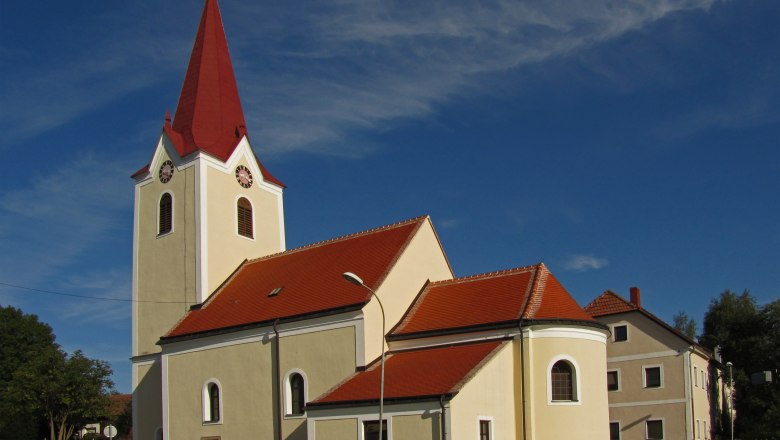
Parish_Church_of_St._Pankratius_in_Wurmbrand©
Description
Information about the church
Wurmbrand is a longitudinal village with an unspoilt village green, which is closed off at the western end by the parish church.
The oldest mention of the name Wurmbrand is in a confirmation by Duke Henry II from 1162 for a donation of part of the Wurmbrand forest to Lambach Monastery by his ministerial Wichard von Arnstein-Gaaden. On the eastern border of this forest, a small fortified complex was probably built soon afterwards by the Lords of Rastenberg and passed to Zwettl Abbey, but it was destroyed around 1300. Under the protection of this fortification, a settlement developed, to which the name of the forest was transferred. It is referred to as "Wormprant" in 1280 and as villa Wurmprant in a Rastenberg foundation from 1293 recorded in the Liber Fundatorum of Zwettl Monastery, in the so-called Bärenhaut. The first documented manorial estate in Wurmbrand is Zwettl Abbey.
The oldest Pankraz chapel (14th/15th century) around 1 km east of the village was deconsecrated in 1785 and is now privately owned as Pankrazihäusl. Our path later leads past it.
A new Pankraz chapel is built in the village in 1736. In 1783, the parish of Wurmbrand was founded and incorporated into Zwettl Abbey. In 1786, the chapel was extended into a Josephine hall church. In 1878, the west tower was added, giving the church its current appearance.
Treat yourself
St. Pancras, patron saint of Wurmbrand parish church, is one of the early Christian martyrs and patron saint of children and young people.
The life of St. Pancratius
St. Pancratius was born in Phrygia around the year 290 and lost his parents at an early age. He came to Rome, where he was converted to Christianity. Despite his young age - he was probably only 14 years old - Pankratius steadfastly refused to renounce his faith when he was arrested during the persecution of Christians under Emperor Diocletian. His deep conviction and courage led to his martyrdom; he was beheaded in 304.
"Treat yourself to yourself"
Although Pancratius was still a teenager, his story shows that he had remarkable inner strength and clarity about his faith. "Treat yourself" in his case could mean that, despite external threats, he found the inner calm and courage to remain true to himself and preserve his deepest conviction - his faith.
Pankratius did not allow the fear of death to deter him from his path. He took the time and space to focus on what was essential: his relationship with God and his Christian convictions. This inner centering enabled him to remain steadfast and unbending in the face of death.
Conclusion
In everyday life, "indulge yourself" in connection with St. Pancras could mean taking the time to look within yourself and strengthen your own faith, values and convictions. It means strengthening yourself internally so that you can face external challenges with calm and steadfastness. Pankratius' life teaches us that true self-care also means centering yourself spiritually and staying true to yourself, no matter what external circumstances prevail.
"I have said these things to you so that in me you may have peace. In the world you have tribulation; but be of good cheer, I have overcome the world." (John 16:33)
This biblical passage reflects the inner calm and peace that Pancrasius found in his faith, even when he was experiencing hardship and persecution.