Schloss Neubruck
Castle, Historical sites
-
Neubruck Castle©
Description
The development of the village of Neubruck in the municipality of Scheibbs is inextricably linked to the industrialist Andreas Töpper - pioneer of the Austrian iron industry and inventor of the rolled sheet metal process - and the iron and rolled sheet metal works he founded in 1820. The village of Neubruck, named after the "New Bridge" built by Töpper over the Erlauf in 1830, eventually emerged from the growing factory settlement.
Before the factory was founded, there was a hammer mill, the "Grießhammer", with a nail forge at the mouth of the Jeßnitzbach stream into the Große Erlauf. Töpper acquired the hammer in 1817, had the old production facilities demolished and built the "first k. k. iron, steel and rolled sheet factory". Töpper was granted the exclusive privilege of producing all types of steel bars using rollers as well as pressed head nails. Due to increasing demand and entrepreneurial skill, the factory became the largest iron and rolled sheet factory in the monarchy, with four iron sheet rolling mills, four iron drawing mills, two cutting mills, six flame furnaces, three cutting furnaces (= smelting furnaces), two large cutting hammers, various drilling and screw cutting mills, forges and other workshops. In the 1860s, the workforce consisted of around 800 people.
The main products were roofing sheets, gutter and pipe sheets, wide ring and tub iron, strip and frame iron, steam boiler sheets and nails. New methods of iron processing made it possible to use coal as a source of energy in addition to water, wood and charcoal. Branch plants were soon established at Lunz and Kienberg. A huge wood drift near Lunz and the coal mines near Gresten supplied the works with fuel.
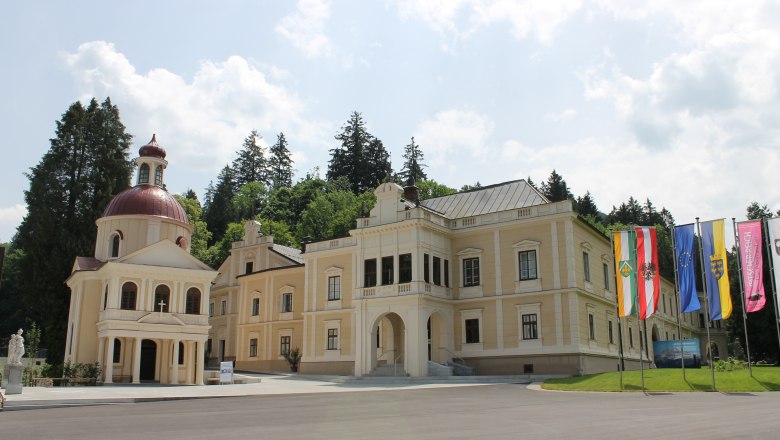
Neubruck as the center of the Töpper empire was conceived as a production site, living space and burial place. Today, the former Töpper factory consists of a chapel, castle (former manor house), park and the factory halls. The workers' houses no longer exist. The manor house, built in 1820 in the park laid out as an English garden, has only survived in the core of the north-western wing of today's castle. The successor to the estate, Eduard Musil von Mollenbruck, had the house converted into a four-winged palace around 1890. The "Töpper Chapel", dedicated to St. Andrew, was built between 1831 and 1834 and was intended as a burial place. In 1882, ten years after Töpper's death, the tombs were moved to the Töpper mausoleum in the former cemetery in Scheibbs.
Töpper's successors had to close the factory, as production methods and patriarchal management had become outdated. The imperial councillor Eduard Musil von Mollenbruck bought the factory and converted it into a paper mill in 1881. Operations had to be discontinued in 1996 - since then the factory halls have stood empty. The entire site fell into a long slumber until it was finally revived as the venue for the Lower Austrian provincial exhibition "ÖTSCHER:REICH - die Alpen und wir" (ÖTSCHER:REICH - the Alps and us) with a functioning reuse concept at the behest of local politicians and other committed personalities. Mostviertel Tourismus GmbH has also been based in Neubruck Castle since March 2016.
(Source: Scheibbs town archive)