Railway hiking trail: Breitenstein-Payerbach
Use our AI guide
Do you have any questions about your stay?

Hiking tour Starting from Breitenstein train station
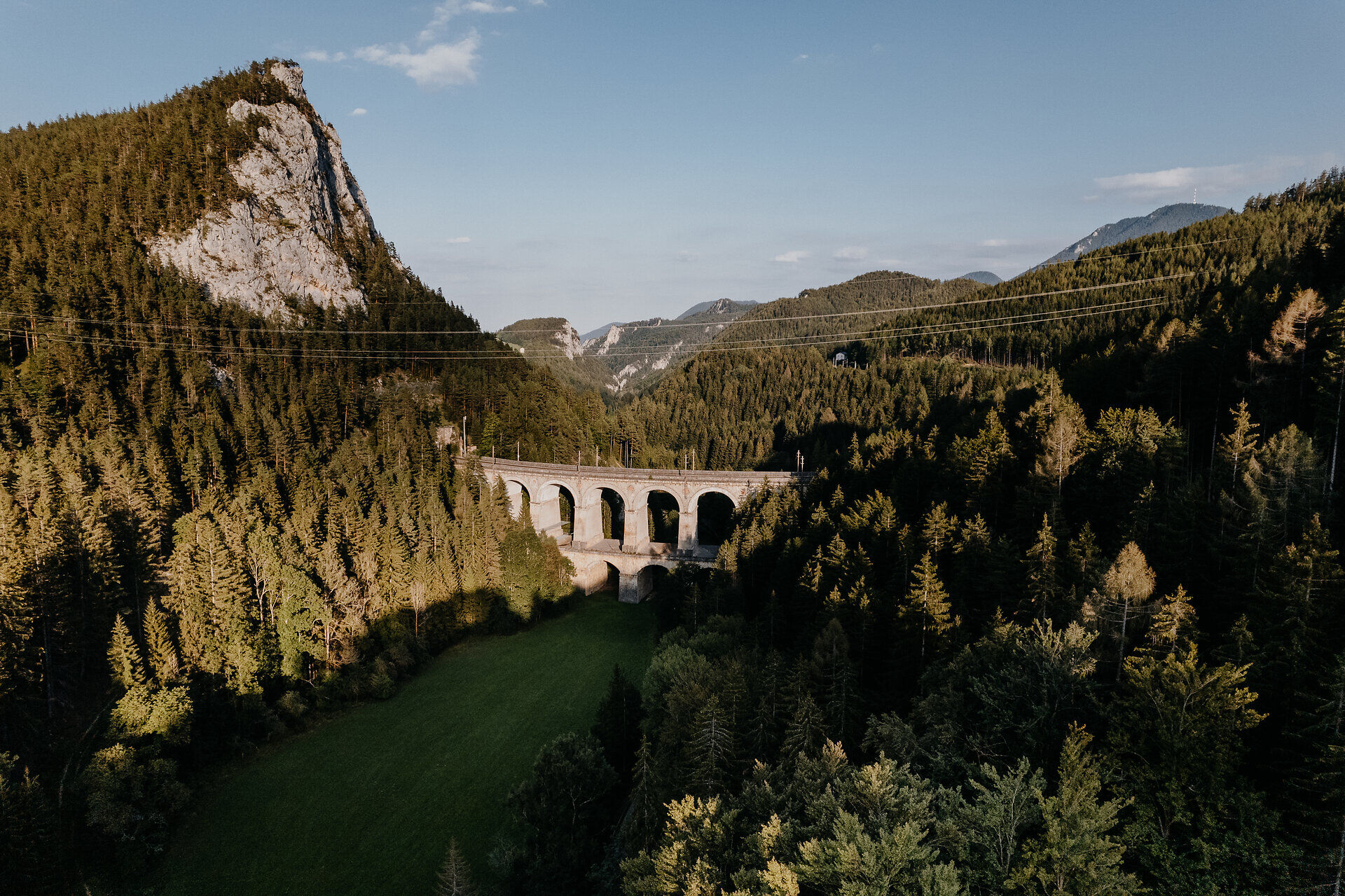
This stage of the railroad hiking trail leads from Breitenstein past the most impressive viaducts and buildings of the UNESCO World Hertige site to Payerbach station.
This stage of the railroad hiking trail leads from Breitenstein past the most impressive viaducts and buildings of the UNESCO World Hertige site to Payerbach station.
From Breitenstein to Payerbach
The railway hiking trail offers a wonderful view of the Semmering railway, a World Heritage Site. From the stop in Breitenstein, you hike along the railroad over the Weinzettelwand with views of the Klamm castle ruins. Here you can continue along the railroad or hike up the Kreuzberg (panoramic route) and stop off at Gasthof Polleres. This route leads through Kochhof and Küb, where you can visit the "Historic Post Office Küb". Once you reach your destination, marvel at the Schwarza viaduct and the historic station building in Payerbach and stop off at the Payerbacherhof.
History of the trail
In the beginning, it was a path that led over the Semmering Pass - there has been evidence of this since the Middle Ages. Then, in the early 18th century, Emperor Charles VI had a road built with a gradient of up to 17 percent, over which horses and their loads laboriously struggled. Finally, in 1841, the order was given to build a railroad line from Vienna to Trieste to meet the transport needs of the beginning industrialization. Finally, in 1844, "only" the gap between Gloggnitz and Mürzzuschlag over the Semmering had to be closed. Under the direction of Carl Ritter von Ghega, 20,000 workers finally built Europe's first full-track mountain railroad, which has only undergone a few changes to this day. Trains travel over 16 viaducts, 100 bridges and through 15 tunnels on the 41 km long line. Since 1998, this "outstanding technical solution to a major physical problem in the construction of early railroads" has been a UNESCO World Hert Hert site.
Your hikes in the Vienna Alps should be a thoroughly enjoyable and safe experience.
Please note the following:
Make sure that the route you choose matches your mountain experience and fitness level. Check the weather forecast beforehand. Weather can change rapidly in the mountains. Therefore, always set out well-equipped (appropriate footwear, rain protection). Check whether the huts and snack stations you want to visit are open. Inform someone about your route choice and planned return before you start. Stay on marked paths and avoid shortcuts. Due to dryness, meadows and forests are easily flammable. Handle fire respectfully and immediately report any possible fire to the fire brigade (122). Do not throw litter into the landscape and dispose of it properly.
Some parts of the path run along grazing areas. Stay on the marked routes and keep a respectful distance from the grazing animals.
8 basic rules in the mountains
Always bring suitable maps. Wear sturdy shoes appropriate for the route, bring sun and rain protection as well as water and a snack. Take your mobile phone with you and save the mountain rescue emergency number: 140
The hike starts at Breitenstein train station. From here, always follow the signs towards Klamm train station. First, go down the street to the town hall. At the intersection, turn left into Lindenstraße, which later becomes a forest path.
At the next fork in the road, you will come across a paved street again. Follow this uphill. On the right is a playground with a locomotive. Continue along the Untere Bahnstraße, which eventually becomes a forest road.
At the end of this forest road, there is an option to hike right over a meadow to the Weinzettlwand. There, two viewpoints offer impressive views of Klamm, Breitenstein, Semmering, and the famous Semmering railway. Please show respect to the grazing animals when crossing the meadow.
Then follow Karl-Schubert-Straße to the Blauer Einschnitt. From there, follow the road downhill to the right. Alternatively, you could hike to Klamm via the Panoramic route and stop at Gasthaus Polleres or Alterhammerhof. Then stay on the forest road. Keep left at the Rumplerviadukt.
After the next railway underpass, turn left onto a meadow path, which is also signposted towards Klamm train station. The path leads to the Gamperlviadukt; here, follow the signposts towards Klamm train station as well.
Go downhill on the forest road, then continue left through a wooden fence. This path leads to the Wagnergrabenviadukt. Cross the bridge and follow the steep path uphill. The path ends at a paved street – the Musikerweg – which leads directly to the church in Klamm.
At the church, go left up the street, then turn right into Deiningerweg, continuing towards Klamm train station. After the train station, keep following the street until you reach the Eichbergstraße intersection. (Here the panoramic route also merges back into the railway hiking trail.)
Opposite the Klammer chapel starts a blue-marked path towards Payerbach. From here, follow the signs Küb–Payerbach and the blue trail marking.
The initially paved street soon becomes a forest road. At the next intersection, follow signs towards Payerbach and Küb post office. After about 400 meters, the blue marking turns right onto a forest path – but at this point, please continue following the forest road.
This leads into Waldwinkelstraße. At the next intersection, go slightly right straight ahead and continue along Waldwinkelstraße. At the following fork, the path goes straight ahead along the yellow signs with the railway hiking trail logo towards Payerbach.
The path now passes Küb train station and continues along the meadows on the blue marked path towards Payerbach until an underpass is reached. Go through it and then follow the path to the left.
The path becomes a street and continues – always following the blue marking – to the town hall Payerbach. From there, cross the bridge and walk straight ahead until just before Payerbach train station, where Bahnhofsweg leads uphill to the right.
Public parking is available at Breitenstein train station.
From Vienna: Take the A2 and S6 to exit 17-Gloggnitz. Take Höllental Str./B27 in Lower Austria. Continue on L4168, Auestraße, Adlitzgrabenstraße, and Semmeringstraße to Hauptstraße in Breitenstein.
From Graz: Take S35 and S6 to exit Spital/S. Take Semmering Ersatz Str./B306, then follow Wellspacherstraße and Semmeringstraße to Hauptstraße in Breitenstein.
Travel comfortably by Southern Railway to Breitenstein train station, where the hike also begins.
Alternatively, book an individual ride on the RUFbus Semmering-Rax.
The following RUFbus stops are on the route:
95 Breitenstein train station
88 Klamm train station
92 Blauer Einschnitt
93 Lower/Upper Bahnstraße
34 Payerbacherhof
35 Payerbach-Reichenau train station
36 Payerbach outdoor pool
TIP: Simply travel individually with the Postbus Shuttle App or the hotline +43 660 900 88 22.
Return trip:
More information and timetables can be found at fahrplan.oebb.at and anachb.vor.at.
Collect good feelings – collect hiking badges: Collect the digital "Railway Hiking Trail hiking badge".
Dining options:
Information:
Vienna Alps in Lower Austria, www.wieneralpen.at, +43 / 2622 / 78960
Tourism office Semmering, www.semmering.at, +43 / 2664 / 20025
Letzte Änderung: 20 May 2026